
Staff Development Portal
From 25 steps to 6: Transforming a painful bureaucratic process into an intuitive, efficient experience
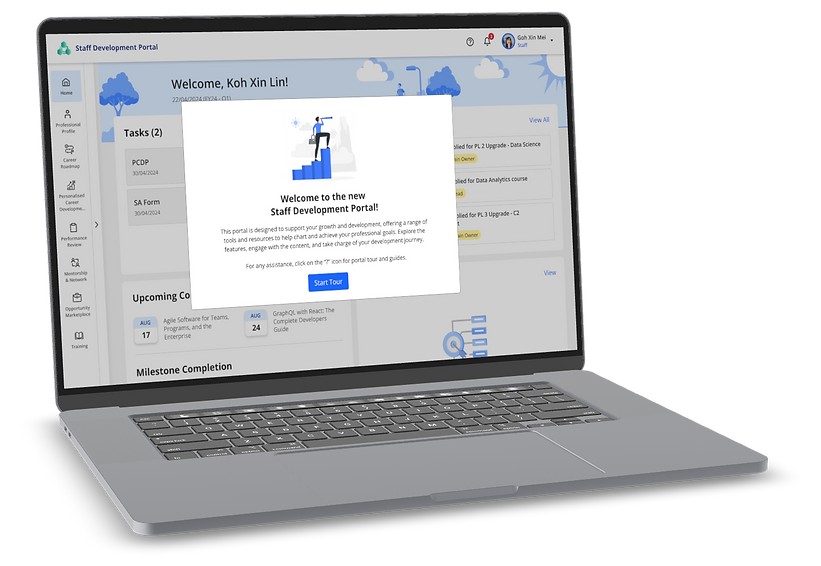
CASE STUDY OVERVIEW
Since 2017, the Staff Development Platform (SDP) has been the organisation's portal for performance reviews, competency upgrades, and career planning. While it served over 4,000 employees, one core function stood out as particularly painful: competency upgrades.
Upgrading competencies—the formal process staff use to demonstrate they've reached a new proficiency level—is crucial for career progression and promotions. But the existing workflow required navigating through 25 tedious, repetitive steps just to upgrade a single domain.
Staff dreaded it. Supervisors found it cumbersome. The process that should have taken minutes stretched into frustrating, multi-stage ordeals.
The transformation 🗻
I led the product design end-to-end, from research and strategy through design delivery and validation. This enhanced portal has gone live after 2 years of work from 2023 to 2025 🥳. We are currently in the process of collecting adoption metrics.
Overall outcomes from testing
✅ Achieved an 83.5 System Usability Scale (SUS) score
✅ Reached 100% customer satisfaction (CSAT) score
✅ Increased Net Promoter Score (NPS) by 167%

THE PROBLEM
A 25-step ordeal for a routine task

One of SDP's core functions is competency upgrades. Staff need to formally document when they've achieved a new proficiency level in their domain—essential evidence for promotions and career advancement.
But the workflow was painfully inefficient.
Here's what staff had to do to upgrade one domain with 3 competency areas:


Hover to view
Total: 25 steps just to upgrade 1 domain
The workflow forced staff to repeat the same actions multiple times—adding logs, previewing, submitting. What should have been a straightforward task became a tedious exercise in system compliance.
The broader context
This workflow was part of a larger platform redesign, but it exemplified the core challenge:
Legacy HR processes had accumulated over years, creating complexity that frustrated users and undermined the platform's purpose.

We needed to understand not just what was broken in the workflow, but what would make it feel natural and aligned with how staff actually work.
DISCOVERY
Design Innovation Phase: Identifying the problem
Rather than jumping to solutions, we invested time understanding pain points across the entire platform through research with staff, supervisors, and HR stakeholders.
We combined depth and breadth:
10
7
329
in-depth interviews 🧐
To explore users’ experiences and frustrations with the existing platform and understand their career development goals.
participants in Co-creation & Card Sorting Workshop 💡
To validate early insights, brainstorm new ideas, and collaboratively reorganise content categories for better usability.
respondents in Organisation-wide Survey 📊
To broaden validation, surface hidden pain points, and prioritise ideas based on input from a wider audience.

The competency upgrade workflow emerged as a critical pain point. Staff described it as tedious, unclear, and frustrating—a process they avoided until forced to complete it.
"Applying for PL [Proficiency Level] is a chore."
"The form is unclear... I avoid the system until the absolute last minute."
💡 The problem wasn't just inefficiency—it was that the system forced staff to think in terms of administrative requirements (separate logs for each area) rather than their actual work (one cohesive project demonstrating competency across multiple areas).
Product Development Phase: Designing & validating the solution
During product development, we designed the new workflow through iterative cycles and internal design critiques. We then conducted prototype testing to validate the streamlined 6-step flow.

Testing confirmed a critical user behaviour: staff typically upgrade the full domain in one go, not area by area.
This validated our design direction—allowing one comprehensive submission, aligned with how users naturally work.
THE SOLUTION
Streamlined workflow from 25 steps to 6 steps —
A 76% reduction in complexity.
We completely reimagined the competency upgrade workflow, eliminating redundancy while preserving all necessary information. Instead of forcing staff to fragment one project into multiple separate submissions, we allowed them to submit one comprehensive justification that covered all competency areas at once.
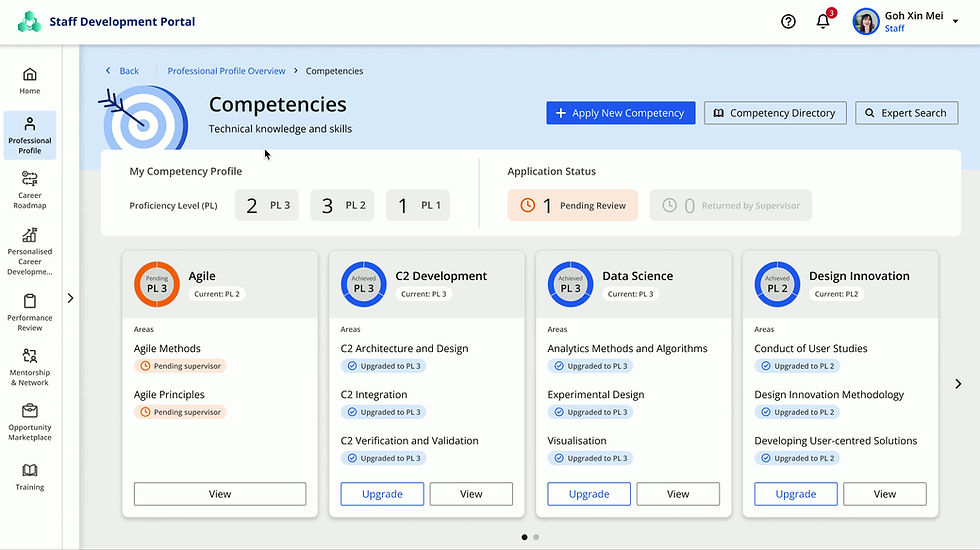
Before
Staff had to:
-
Add multiple separate logs (one per competency area)
-
Fill in repetitive information multiple times
-
Preview and submit each area individually
-
Navigate through 25 disconnected steps
After
Staff can now:
-
Submit one cohesive justification covering all areas
-
See all requirements at once with clear guidance
-
Complete the entire process in 6 straightforward steps
-
Understand exactly what's expected at each stage
OUTCOME & IMPACT
The transformation was both practical and emotional. Staff went from dreading the process to finding it intuitive and even pleasant.
"Straightforward application process compared to the current."
"Feels more relaxing now, previously it felt very tedious."
"Aesthetically pleasing, like cards form, subparts are clear... a lot nicer and clearer than what we have now."
Our solution removed friction, confusion, and frustration. The process that used to feel like bureaucratic paperwork now felt like a natural part of documenting growth.
Impact on the broader platform
The competency workflow redesign was one part of a larger platform transformation that I headed.
The overall SDP redesign achieved:

✅ Achieved an 83.5 System Usability Scale (SUS) score - indicating "excellent" usability
✅ Reached 100% customer satisfaction (CSAT) score - every user satisfied with the new experience
✅ Increased Net Promoter Score (NPS) by 167% - staff shifted from detractors to promoters
REFLECTIONS
The 25-step workflow existed because of accumulated legacy decisions, not because it was the best solution. Just because a process has always been complex doesn't mean it needs to stay that way.
The lesson: Think beyond the surface. Ask "why does this need to be done this way?" and challenge complexity at its root.
Challenge "the way we've always done it"

Build systems that match how users think
The breakthrough came from recognising that staff think about their work as cohesive projects, not fragmented administrative categories.
The lesson: When there's a mismatch between system structure and user mental models, simplify the system—don't ask users to do extra cognitive work.

Process improvements are emotional transformations
Reducing steps from 25 to 6 wasn't just about efficiency—it changed how staff felt about the entire platform. What was tedious became "relaxing". What was confusing became "intuitive".
The lesson: How something feels matters as much as how well it functions. Small changes in process can create big emotional shifts.

Want to learn more? 😄
This case study showcases one transformation within a larger platform redesign. Beyond streamlining the competency workflow, I also tackled challenges around career planning, mentorship connections, and making the entire experience feel more human and engaging.
I'd love to discuss:
-
The other problems we solved across the Staff Development Portal
-
How we balanced user needs with legacy technical constraints in an enterprise environment
-
The research methods that uncovered critical insights and gained stakeholder buy-in